


Industrial extraction systems cannot use the same filtration method for every contaminant. A solution that handles dry wood dust is not automatically suitable for welding fume. A dry-dust cartridge is not a replacement for an oil-mist separator, and a mechanical particle filter cannot by itself remove volatile organic compounds from paint, solvent or adhesive processes.
Airborne industrial contamination may contain coarse dust, fine particles, fume, liquid aerosols, vapours, odours or a combination of several phases. Each behaves differently in the air and requires a compatible capture and treatment strategy. Correct filtration protects people, equipment and process stability; incorrect filtration may block quickly, consume excessive energy or allow the target pollutant to pass through.
What filtration means in an extraction system
A complete system captures the contaminant at its source, transports it through ductwork and separates it from the air in one or more treatment stages. Weak capture allows the pollutant to escape before it reaches the filter. Poorly sized ducting prevents the required airflow. A filter selected for the wrong state of matter cannot perform the intended separation.
Filtration is therefore selected primarily by the contaminant, then by airflow, loading, temperature, humidity, maintenance access and discharge requirements. Available technologies include cyclones, bag and cartridge filters, paint-overspray media, mist separators, coalescing stages and activated carbon for suitable vapour applications.
Dust, fume, VOCs and oil mist: the essential difference
| Contaminant | Physical form | Typical sources | Suitable treatment principles |
|---|---|---|---|
| Dust and particles | Solid | Woodworking, grinding, mixing, dosing and material handling | Cyclonic pre-separation, bag or cartridge filtration |
| Industrial fume | Very fine solid particles and condensed vapours | Welding, thermal cutting, brazing and hot processes | Close source capture and fine-particle filtration |
| VOCs | Gas or vapour | Painting, coating, adhesives, solvents and degreasing | Compound-specific treatment; activated carbon where technically suitable |
| Oil or emulsion mist | Liquid aerosol | CNC machining, turning, milling and grinding with coolant | Mist separation and coalescing filtration |
| Mixed emissions | Solid, liquid and/or vapour | Paint shops and complex finishing lines | Purpose-designed multi-stage treatment |
Filters for dust and solid particles
Dust filtration is used where the main pollutant is a dry solid. Particle size, concentration, abrasiveness, moisture, tendency to agglomerate and combustibility all affect the design. Woodworking systems may need to handle chips, sawdust and fine sanding dust in the same network. Metal grinding can produce abrasive particles that wear bends and filter components. Food and pharmaceutical powders can add hygiene and cross-contamination requirements.
Bag filters
Bag filters are well suited to many high-dust-load applications. Their medium, filtration area and cleaning method must match the material. A medium that is too restrictive increases pressure loss; one that is too open may not retain the target particle fraction. Mechanical or pulse-jet cleaning maintains permeability, while safe material discharge prevents the hopper from backing up into the filter.
Cartridge filters
Pleated cartridges provide a large filtration area in a compact arrangement and are often used for fine dry dust and fume. Sticky, wet or oily material can rapidly blind a cartridge intended for dry service. Abrasive particles may damage the medium, and excessive air-to-media loading can shorten element life even when the nominal filter rating appears adequate.
Filtration for industrial fume
Welding and thermal cutting create fine particles that rise and disperse quickly. Capture arms, hoods, enclosures or downdraft tables must intercept the plume close to its origin. Filtration then addresses the fine-particle load. General room ventilation may support air balance, but it cannot replace properly positioned local extraction for a concentrated source.
Common errors include positioning an arm too far away, drawing the plume through the operator’s breathing zone, using coarse-dust media and allowing pressure drop to rise until source capture collapses.
VOC treatment and activated carbon
Volatile organic compounds are vapours released by substances such as paints, lacquers, thinners, adhesives, resins and degreasers. They are not captured effectively by ordinary bag or cartridge filters. The specific compounds, concentrations, temperature, humidity and airflow must be understood before a treatment method is selected.
Activated carbon adsorbs suitable vapour molecules on its internal surface. Its performance depends on the compound, bed quantity, contact time and operating conditions. Particles and paint overspray should be removed upstream so that they do not coat the carbon. Saturation may occur without a dramatic mechanical pressure increase, which is why service life and replacement are planned from process data rather than odour alone.
Activated carbon is not a universal VOC solution. High concentrations, unsuitable compounds or process conditions may require another technology or a combined treatment approach.
Oil- and emulsion-mist filtration
Machining fluids can become fine liquid droplets during turning, milling, drilling and grinding. Oil mist deposits a film on machines, floors and ductwork and behaves very differently from dry dust. A standard dry filter can become wet and blocked, leading to unstable airflow and frequent maintenance.
Mist separators and coalescing filters encourage fine droplets to combine into larger drops that can drain from the airflow. Capture is ideally connected to the machine enclosure so that mist does not escape into the hall. Drainage, fluid compatibility and access for cleaning are integral parts of the design.
Why multi-stage filtration is often necessary
A paint process can produce both overspray particles and VOCs. A machining process can combine metal particles with coolant aerosol. Finishing lines may generate dust during preparation and vapours during coating. One filter cannot address every phase effectively.
Multi-stage treatment assigns a clear role to each stage. A pre-separator removes coarse material, a fine filter captures smaller particles, a mist stage removes droplets, and a vapour stage treats compatible compounds. Upstream stages protect the final medium and extend service intervals.
How to select the filtration system
Selection begins with a documented contaminant profile:
- solid, liquid or vapour phase and any combination between them;
- particle size, concentration, abrasiveness, stickiness and moisture;
- chemical identity and concentration of vapours;
- air temperature, humidity and potential condensation;
- process duration, peak load and simultaneous sources;
- combustibility, ignition sources and corrosion conditions;
- required collection, drainage or waste-discharge method.
The filter must handle the required airflow without excessive pressure loss. Maintenance access, consumable availability, cleaning controls and safe waste handling are evaluated before purchase, not after installation.
Application examples
| Application | Main contaminant | Typical approach |
|---|---|---|
| Wood sanding | Fine dry wood dust | Local capture with bag or suitable cartridge filtration |
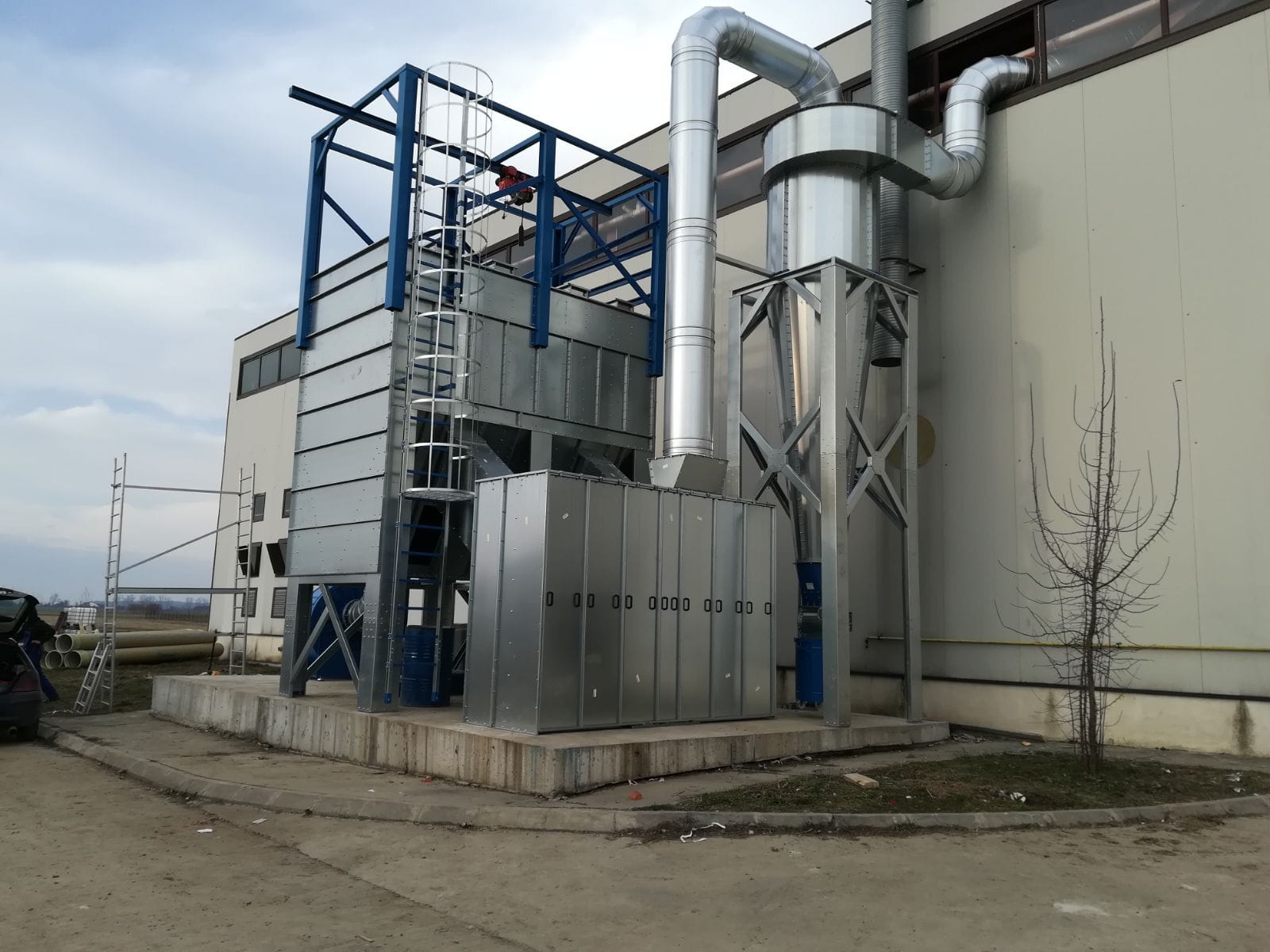
| Wood cutting and routing | Chips, sawdust and dust | Duct network, cyclone/pre-separation and central filtration |
| Metal grinding | Abrasive particles | Robust local capture, pre-separation and abrasion-aware filtration |
| Welding | Fine fume | Extraction arm or hood with fine-particle filtration |
| Painting | Overspray and possible VOCs | Particle prefiltration followed by compound-specific vapour treatment where required |
| CNC machining with coolant | Oil or emulsion mist | Machine capture with mist separator/coalescing stages |
Safety and lifecycle cost
Filtration influences more than visual cleanliness. Dust deposits can affect equipment and may create fire or explosion hazards when the material is combustible. Oil mist can create slippery deposits. Fume and vapours require controls appropriate to their composition. Risk measures are based on the actual materials and process, not on the filter name alone.
A low purchase price can be offset by high energy use, frequent element changes, cleaning downtime or premature wear. Lifecycle cost includes pressure loss, replacement frequency, compressed-air consumption, maintenance labour and production stability.
Signs that filtration is unsuitable
- filters block much faster than expected;
- capture airflow drops soon after cleaning or replacement;
- dust or fume appears downstream of the filter;
- odours persist because a particle filter is being asked to treat vapours;
- oily films appear in the hall or in dry-filter ductwork;
- energy consumption rises as pressure loss increases;
- maintenance access or collected-material removal is impractical.
Filtration is one part of a complete system
A new filter cannot correct a capture hood that misses the plume, leaking ductwork or a fan operating outside its duty point. The engineering review must follow the complete air path from source to discharge. This approach identifies whether the actual problem lies in capture, transport, treatment, air balance or maintenance.
Browse ALWO industrial filtration equipment or contact us with the contaminant, process and operating data for your application.


