


Industrial fume is one of the most difficult forms of airborne contamination to control in a production environment. Unlike coarse dust that settles visibly, fume consists mainly of very fine particles and condensed vapours that remain suspended and follow air currents. It is generated by welding, thermal cutting, brazing, heat treatment, grinding and metallurgical processes in which materials are heated, melted, oxidised or otherwise transformed.
Fume should not be treated as a simple visibility or odour problem. It can enter an operator’s breathing zone, contaminate surfaces, load the building ventilation system and affect sensitive equipment. When fume is mixed with metal dust, abrasive particles, hot sparks, oil mist or process vapours, the extraction strategy becomes more complex.
The core engineering rule is to capture the emission as close as practicable to the source. Once fume has dispersed through a large hall, a much greater volume of air must be moved and treated. Local exhaust ventilation keeps the contaminant concentrated and makes performance easier to control.
What industrial fume contains
Industrial fume may contain fine solid particles, condensed vapours and process gases. Its composition depends on the base material, filler, coating, oil, flux, previous surface treatment and operating temperature. Welding fume can originate from both the workpiece and consumables. Thermal cutting produces fine oxides and hot particles. Heat-treatment emissions can include vapours from oil, residues and process atmospheres.
Because many fume particles are very small, they can remain airborne for a long time. Thermal buoyancy often creates a rising plume. If that plume is not intercepted immediately, cross-draughts and operator movement can carry it away from the capture device.
Why general ventilation is not enough
General ventilation can provide make-up air, remove excess heat and dilute low-level background contamination, but it acts on the entire room volume. A welding arc or cutting torch is a concentrated source located close to the worker. Fume may therefore pass through the breathing zone before it reaches a general exhaust point.
Local extraction acts on the emission before it mixes with the room air. General ventilation and local exhaust can work together: the local system controls the main sources, while the building ventilation maintains a stable air balance and manages residual heat or background emissions.
Source capture: the decisive factor
Capture efficiency falls rapidly as the distance from the source increases. A flexible extraction arm used for manual welding should be close enough to intercept the plume without obstructing the operator or drawing fume across the operator’s face. If it is awkward to position or does not remain in place, it is unlikely to be used consistently.
For thermal cutting, extraction is often integrated into a zoned downdraft table. Only the active section is opened to the extraction network, which controls fume without moving unnecessary air across the entire table. Heat-treatment applications may use overhead hoods, side capture or partial enclosures designed around the natural rise of hot contaminated air.
Typical solutions by process
| Process | Main emissions | Typical capture method | Important design point |
|---|---|---|---|
| Manual welding | Fine fume and metal oxides | Extraction arms, local hoods or mobile units | Capture must remain close and draw away from the breathing zone |
| Robotic welding | Repeatable concentrated fume | Integrated hood or partial enclosure | Coordinate extraction with the cell and robot movement |
| Plasma cutting | Dense fume and fine particles | Zoned downdraft cutting table | Airflow must match the active table zone |
| Laser cutting | Very fine fume and vapours | Machine-integrated extraction | Protect the workplace and sensitive machine components |
| Oxy-fuel cutting | Fume, oxides and hot particles | Downdraft table or local hood | Assess sparks and hot-particle transport |
| Heat treatment | Hot contaminated air, vapours and smoke | Top or side hoods and enclosures | Allow for temperature, buoyancy and condensation |
| Metal grinding | Abrasive metal dust and occasional fume | Downdraft bench or local hood | Use components suitable for abrasion and spark conditions |
Welding-fume extraction
MIG/MAG, TIG, shielded-metal-arc and other welding processes generate different quantities and compositions of fume. The material, current, shielding gas, filler, coating and cleanliness of the part all influence the emission. Manual welding generally needs a flexible capture device; fixed repetitive work may use a downdraft table or purpose-designed hood; robotic cells can often be partially enclosed.
The airflow should carry the plume away from the operator, not across the face. Training is part of the control measure because the position of a movable arm can determine whether an otherwise capable system performs properly.
Fume extraction for thermal cutting
Plasma, laser and oxy-fuel cutting can produce dense clouds of fine particles. A cutting table with zoned extraction captures emissions below the workpiece near the active cutting area. The required airflow is determined by the table design, active zone, material and operating conditions, together with losses through ducting and filtration.
Plasma cutting often imposes a high particle load. Laser processes can generate extremely fine fume that may affect optics and internal machine components if extraction is inadequate. Oxy-fuel cutting requires attention to hot particles and ignition sources travelling toward the filter.
Heat-treatment and metallurgical processes
Heat-treatment sources may be larger than a single welding point: furnaces, baths, quenching stations, heated lines and handling positions can all release smoke or vapour. The hood must account for the rising thermal plume, side draughts, source geometry and the way parts are loaded and unloaded. Partial enclosures can reduce the air volume required while still preserving access.
Metallurgical areas may combine fume, abrasive dust, sparks, hot particles and oil aerosols. These streams should not automatically be connected to the same network. Separate circuits or treatment stages may be needed when contaminants have incompatible properties or different filtration requirements.
Filtration for industrial fume
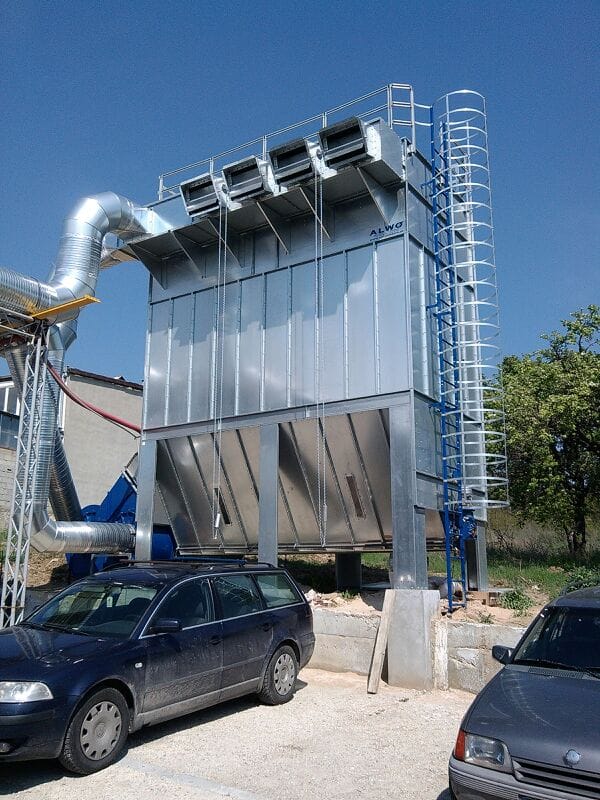
Fume filtration is not the same as coarse-dust separation. Cartridge filters are frequently used for fine particles, but the medium, surface area and cleaning system must match the fume composition, temperature and loading. Multi-stage treatment may be required when hot particles, sparks, coarse dust, vapours or odours are present with the fume.
Filter pressure drop rises as the elements load. If the filtration area is too small or cleaning is ineffective, system airflow falls and source capture deteriorates. Differential-pressure monitoring and planned maintenance reveal this change before visible fume begins escaping into the hall.
Ductwork and centrifugal fans
The duct network carries contaminated air from each capture point to the treatment unit. Diameters, branch geometry and routing are selected for the required airflow and acceptable pressure loss. Undersized ducting creates excessive resistance; oversized ducting may reduce transport velocity and allow mixed dust or particles to settle.
Centrifugal fans are commonly used because they can overcome the resistance of hoods, ducting and filters. Selection must include the complete system pressure, not airflow alone, and should account for both clean and normally loaded filter conditions. An oversized fan can create noise, unnecessary energy use and excessive replacement-air demand; an undersized fan cannot maintain capture.
Mobile or centralised extraction?
Mobile units suit occasional work, changing locations and small numbers of welding stations. They are flexible but have limits in airflow, filter capacity and simultaneous use. A centralised system is often appropriate for repeatable production with several fixed sources, where common filtration and organised maintenance provide operational advantages.
Central systems require a simultaneity assessment and branch balancing. Some facilities combine a central network for regular production with mobile units for maintenance and temporary tasks.
Safety considerations
Sparks, hot particles, combustible dust and flammable residues must be evaluated before equipment is selected. Depending on the documented risk, the system may require spark separation, detection and extinguishing, suitable materials, explosion protection or isolation. These measures are application-specific and should be integrated with housekeeping and maintenance procedures.
Common design and operating mistakes
- placing the capture point too far from the plume;
- relying on room ventilation instead of local source capture;
- selecting a fan by nominal airflow without calculating total pressure loss;
- using coarse-dust filtration for fine fume or ignoring mixed vapours and aerosols;
- connecting incompatible processes to one network without analysis;
- ignoring sparks and hot-particle transport;
- failing to train operators in positioning movable extraction arms.
Maintenance and performance
A maintenance plan should cover filter pressure drop, airflow at representative capture points, duct integrity, fan condition, arm joints, gate operation, deposited material and safety devices. Filters are cleaned or replaced according to condition and operating data, not only when the system has obviously lost suction.
Stable extraction improves visibility, limits deposits on equipment and reduces unplanned cleaning. It supports productivity by keeping the process environment predictable rather than allowing air quality to decline between emergency interventions.
Choosing the right solution
Selection begins with the process: emission type, material, duration, operator position, available space and simultaneous demand. The capture method is defined first, followed by the branch airflow, duct network, treatment stages and fan duty. There is no universal industrial-fume system; the effective solution is the one engineered around the real process.
Explore ALWO equipment for industrial fume extraction and centrifugal fans, or contact our team with details of your welding, cutting or heat-treatment application.


